DATOUBOSS vs ECO-WORTHY: The Ultimate Home Backup Showdown 🔋🏡
If you’re building a home solar backup system or upgrading your off-grid setup, you’ve probably come across two heavy-hitters on AliExpress: the DATOUBOSS 51.2V 100Ah 5.12KWh LiFePO4 Battery and the ECO-WORTHY 48V 100Ah LiFePO4 Lithium Battery. Both promise serious capacity for solar storage, but only one comes with full UL listed solar battery certification — and that difference matters a lot more than most buyers realize. 🏠☀️
In this guide, we compare specs, safety certifications, pricing, and real value so you can pick the right home battery backup for your setup. Let’s dive in. 👇
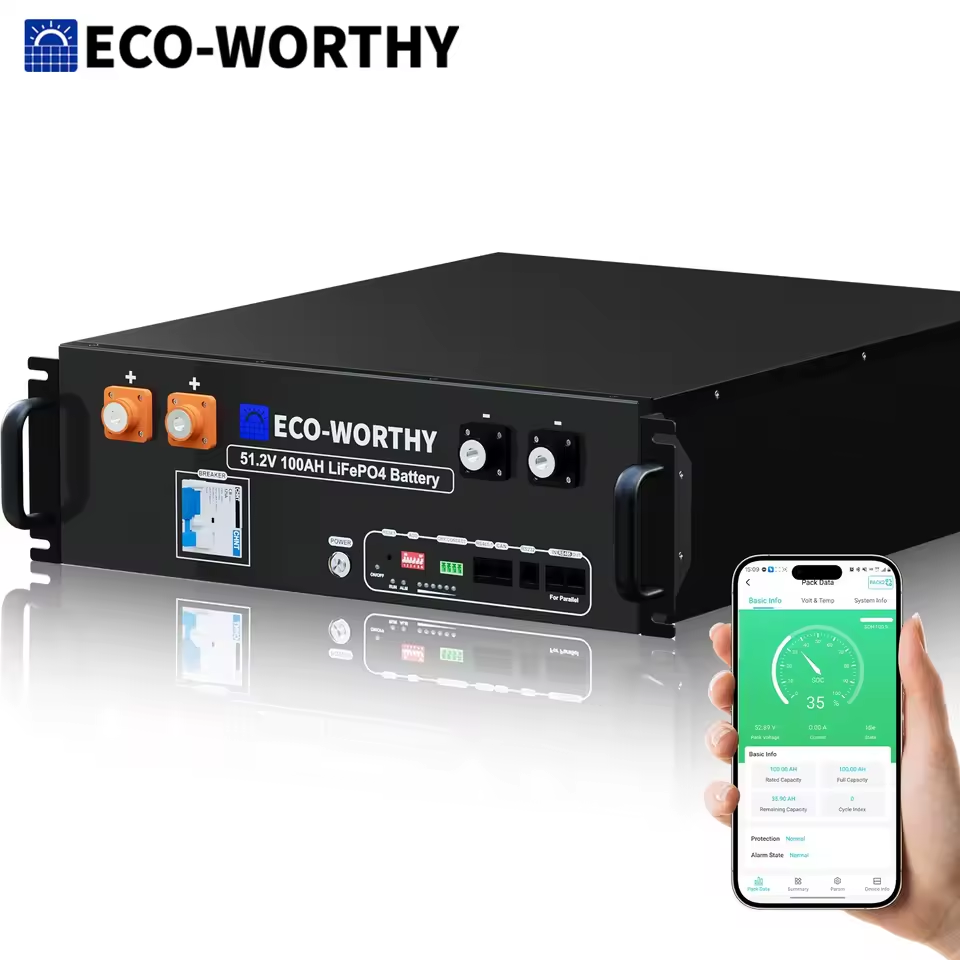
⚡ Quick Overview
The DATOUBOSS 51.2V 100Ah 5.12kWh LiFePO4 Battery is a rack-mounted battery built with Grade A cells, a built-in 100A BMS, 6000+ rated cycle life, and Bluetooth app monitoring. It’s listed at $1,993.79 (down from $6,324.35), with 307 units sold and a 4.8-star rating.
The ECO-WORTHY 48V 100Ah LiFePO4 Battery offers a similar 5120Wh capacity but stands out with UL1973 & UL9540A certification plus CEC listing — meaning it has been independently tested for safety and code compliance. It’s currently priced at $693.00 (down from $1,741.20), backed by 500+ seller sales and a 4.9-star rating.
👍 Click Below to Check the Latest Price & Deals
🛡️ Why UL Certification Actually Matters
If you’ve searched for a UL listed solar battery, you already know installers, insurance companies, and local codes increasingly require it. UL 9540 is the industry benchmark safety standard for energy storage systems, evaluating everything from thermal runaway resistance to electrical safety. A battery without this certification might still work fine — but it can complicate permits, insurance claims, or resale value down the line.
This is exactly where the ECO-WORTHY pulls ahead: it’s UL1973 and UL9540A certified plus CEC listed, giving you documentation that satisfies most local solar installation requirements. The DATOUBOSS listing doesn’t highlight equivalent certification, which is worth factoring in if you’re doing a permitted, code-compliant install.
🔧 Capacity & Build Quality
Both batteries deliver comparable capacity in the 5kWh range, making them solid choices for a solar storage setup or as a server rack battery for continuous power needs. The DATOUBOSS uses Grade A cells with a 100A BMS and lists a longer advertised cycle life (6000+ cycles), while the ECO-WORTHY comes in a rack-mount enclosure with dual charge/discharge ports and a companion app for real-time monitoring of voltage, capacity, and cycle index.
For most home battery backup applications, either battery will comfortably power essential appliances during an outage or store solar energy for evening use.
💰 Price Comparison Table
| Feature | ECO-WORTHY 48V 100Ah ⭐ Best Value | DATOUBOSS 51.2V 100Ah |
|---|---|---|
| Price | $693.00 (~60% off) | $1,993.79 (~68% off) |
| Capacity | 5120Wh (100Ah) | 5.12kWh (100Ah) |
| Certification | ✅ UL1973, UL9540A, CEC Listed | Not specified |
| BMS | Built-in, Bluetooth app | Built-in 100A BMS, Bluetooth app |
| Cycle Life | Standard LiFePO4 lifespan | 6000+ cycles (rated) |
| Rating | 4.9★ (500+ sales) | 4.8★ (307 sold) |
| Best For | Code-compliant solar backup | High-capacity power users |
| Where to Buy | Check price → | Check price → |
👍 Our pick: At $693, the ECO-WORTHY delivers nearly identical usable capacity to the DATOUBOSS’s $1,993 price tag — plus the UL/CEC certification that many solar installs actually require. Unless you specifically need the DATOUBOSS’s extended 6000+ cycle rating for heavy commercial use, the ECO-WORTHY is the smarter buy for most homeowners.
📊 Key Specifications at a Glance
| Spec | ECO-WORTHY | DATOUBOSS |
|---|---|---|
| Nominal Voltage | 48V | 51.2V |
| Cell Type | LiFePO4 | Grade A LiFePO4 |
| Form Factor | Rack-mount enclosure | Rack-mount enclosure |
| Monitoring | Bluetooth app, State of Charge screen | Bluetooth app |
| Units Sold | 500+ | 307 |
🔌 Battery Charging & Compatibility
Both batteries pair well with standard solar charge controllers and inverters, and if you’re setting up a full system, you’ll also want a reliable lithium battery charger on hand for backup charging scenarios (grid-assist or generator charging). Look for a charger rated for 48V/51.2V LiFePO4 chemistry specifically — using the wrong charge profile can shorten battery lifespan significantly.
If you’re also considering a power station as a smaller, portable complement to your home battery backup, know that dedicated rack-mounted batteries like these two options offer far more capacity per dollar than portable power stations — they’re just not portable. Think of the ECO-WORTHY and DATOUBOSS as your “whole home” solution, and a power station as your grab-and-go backup for camping or short outages.
🤔 Verdict: Which Should You Buy?
✅ Go with the ECO-WORTHY if:
- You need UL1973/UL9540A certification for a permitted, code-compliant install
- You want to save over $1,300 while getting nearly the same capacity
- You want CEC-listed compliance for rebate eligibility in applicable states
- You want strong seller trust (500+ sales, 4.9★ rating)
⚠️ Consider the DATOUBOSS if:
- You need the longest possible rated cycle life (6000+ cycles) for heavy daily cycling
- You’re building a large-scale off-grid or commercial system where budget is less of a constraint
- Certification isn’t a requirement for your installation
For the vast majority of homeowners searching for a solar backup battery or home battery backup, the ECO-WORTHY is the more practical, cost-effective, and code-friendly choice. The DATOUBOSS isn’t a bad battery — it just has to justify a nearly $1,300 price gap with specs that don’t clearly outperform its rival where it counts most: safety certification.
🔍 Detailed ECO-WORTHY 48V 100Ah Review
The ECO-WORTHY 48V 100Ah stands out most for its UL1973 and UL9540A certification combined with CEC listing — a level of independent safety testing that’s rare to find at this price point. For homeowners who need code-compliant equipment (required in many states for solar rebates and permits), this certification alone can make the ECO-WORTHY the smarter long-term investment, even with slightly less advertised capacity than the DATOUBOSS.
🖥️ Is It Also a Good Server Rack Battery?
If you’re setting up a home lab, server rack, or telecom backup system, both units can double as a practical server rack battery option thanks to their standard rack-mount form factor. The DATOUBOSS 51.2V 100Ah fits into a standard 19-inch rack enclosure alongside networking equipment, while the ECO-WORTHY 48V 100Ah offers similar rack compatibility at a lower price point — making either one a workable choice for keeping servers, routers, and networking gear running during outages.
💵 Which One Offers the Most Affordable Home Battery Backup?
If your top priority is an affordable home battery backup without compromising on safety, the ECO-WORTHY 48V 100Ah is the clear budget winner — priced at $693.00 (down from $1,741.20), it delivers UL-certified peace of mind at less than half the DATOUBOSS’s cost. That said, the DATOUBOSS’s slightly higher rated capacity (5.12kWh vs ECO-WORTHY’s 5120Wh) and Bluetooth app monitoring may justify the higher price tag for buyers who need maximum runtime and remote diagnostics.
❓ Frequently Asked Questions (FAQs)
How much do solar batteries cost?
A quality solar battery for home backup typically ranges from $600 to $2,500+ depending on capacity and certification. As shown in this comparison, the UL-certified ECO-WORTHY at $693 proves you don’t need to spend thousands to get a reliable 5kWh solar storage battery — though larger, high-cycle-life options like the DATOUBOSS can run closer to $2,000.
How long do solar batteries last?
Most LiFePO4 solar backup batteries are rated for 4,000–6,000+ charge cycles, which translates to roughly 10–15 years of daily use. The DATOUBOSS’s 6000+ cycle rating puts it on the higher end, while the ECO-WORTHY still offers a solid, dependable lifespan for typical home battery backup use.
How do I charge a lithium battery correctly?
Always use a lithium battery charger specifically rated for LiFePO4 chemistry (typically 48V or 51.2V for these models). Charging with the wrong voltage profile — like a standard lead-acid charger — can damage the cells or void your warranty. Most rack-mounted batteries like these also support solar charge controllers and grid-assist charging through a compatible inverter.
Is a UL listed solar battery worth paying extra for?
Yes, especially if you’re doing a permitted installation. A UL listed solar battery — certified under UL1973 and UL9540A — has been independently tested for safety and code compliance, which many local permitting offices and insurance providers now require. It can also matter for solar rebate eligibility, since CEC-listed products often qualify for state incentive programs.
Can I use a power station instead of a home battery backup?
A power station is great for portability — camping, RV trips, or short outages — but it can’t match the capacity-per-dollar of a dedicated rack-mounted solar backup battery like the ECO-WORTHY or DATOUBOSS. For whole-home backup or serious solar storage, a fixed LiFePO4 battery bank is the better long-term investment.
What’s the difference between a server rack battery and a regular home battery?
A server rack battery (like both models in this comparison) is designed to be mounted in a standard 19-inch rack enclosure, making it easy to stack multiple units for scalable capacity. This design is popular for both home energy storage and small commercial setups where space efficiency and modular expansion matter.
What is a UL listed battery?
A UL listed battery is a unit that has been independently tested and certified by Underwriters Laboratories for safety. It confirms the battery meets strict electrical and fire safety standards. For homeowners in the USA, using a UL listed battery like the ECO-WORTHY model is often expected — and sometimes required — by local building codes and insurance providers.
How does Tesla’s Powerwall compare to these models?
Tesla’s Powerwall is a premium, professionally installed option that typically costs significantly more than rack-mounted LiFePO4 batteries like these. For DIY-friendly setups, the DATOUBOSS and ECO-WORTHY models offer a notably better price-to-capacity ratio, though they lack Tesla’s integrated installation and support ecosystem.
What makes a solar battery reliable for daily cycling?
Long-term durability for daily cycling comes down to using Grade A LiFePO4 cells paired with a high-quality BMS. In this comparison, the ECO-WORTHY’s combination of independent certification and a solid cycle count makes it a strong candidate for buyers prioritizing dependable daily use over many years.
Importance of Safety Standards
It’s worth verifying the relevant UL certifications for any battery system before purchasing. These safety standards help confirm the unit can handle high temperatures and electrical surges without added risk.
Reliability for Off-Grid Living
Whether you’re building a solar setup in a remote rural area or a city home, durability is key. Batteries that carry independent safety certification, like the ECO-WORTHY’s UL1973/UL9540A listing, give off-grid buyers extra confidence in long-term performance.
🏁 Final Thoughts
Both the DATOUBOSS and ECO-WORTHY show that high-capacity LiFePO4 batteries are more accessible than ever for home solar and backup power needs. But when you weigh certification, price, and real-world trust signals side by side, the ECO-WORTHY at $693 stands out as the stronger deal over the DATOUBOSS at $1,993.
Whether you’re going off-grid, building resilience against outages, or simply want to store solar energy more efficiently, both batteries get the job done — but the ECO-WORTHY does it with better documentation and a much friendlier price tag.
Get the deal alert, not the spam.
One email when this exact product — or something we've personally tested and rated — drops to its lowest verified price. No daily emails, no random affiliate spam, unsubscribe anytime.
Looking for More Deals Like This?
Browse verified AliExpress listings with live pricing and honest ratings.